
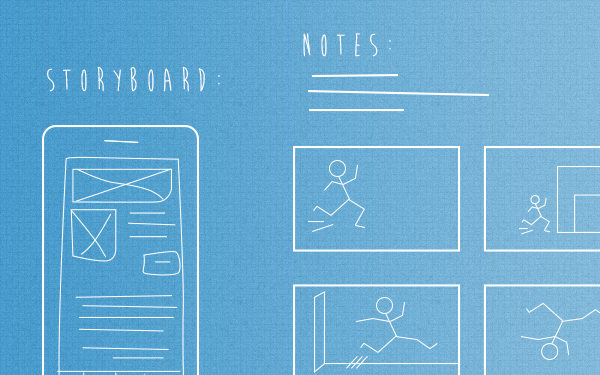
Invented by Walt Disney, storyboarding is the idea of providing a visual narrative to communicate a procession of ideas. In business, it can be utilized to offer your content a sense of purpose furthering your overall business strategy. In fact, one of the most egregious content errors involves the lack of a strategy that encompasses core themes supporting your business direction. Involving a storyboard in your content strategy enables any company to better direct their content initiatives in both macro and micro levels. A properly sketched storyboard offers your content strategy a “true North”, not only giving it direction but also propelling your efforts forward in a conducive manner that just makes sense to your audience. Readers flocking to your blog shouldn’t have to wonder what your content is about. They should be able to quickly identify your purpose and value, which a strong storyboard provides.
Steps to Creating Your Content Storyboard
Identify the Problem. Ask yourself what your ultimate goal is. What do you want to talk about? Start by going through any past articles you’ve written or bookmarked. Include any books you’ve read, seminars, networking, or conferences you’ve attended. What sort of people have you flocked around the most lately? This is where you should start seeing themes pop up.
Expect this to take a while, especially if you’re working with a team. If working with a remote team, then ask them to come up with resources and priority lists ahead of time. For example, what two major themes or issues can they identify, versus lesser priority issues. Invite them to draw out their ideas with a flow chart that shows hierarchies and how themes relate to one another. While graphic designers will excel in this area, just about everyone is capable of offering a digital illustration through the use of Paper by FiftyThree, an Apple app.
Find the Gaps. In movies you always see sleuths and detectives piecing the story together by having a central wall or white board where ideas are jotted. This move isn’t just theatrics. In fact, it’s a proven process particularly successful for visual learners. It gives us the opportunity to actually see what’s going on, and it provides us with the chance to make connections. Our job as content strategists is to find those connections. So when you’re storyboarding, keep in mind that you’re looking for either missing pieces of the puzzle, key themes, or keywords that bridge ideas.
Let Your Thoughts Saturate. Don’t be quick to make a decision. The best ideas need time to saturate; your mind needs time to process what its just seen. Giving yourself and the team a couple days to reconvene before deciding on a strategy provides an opportunity to take in what just happened. It gives you the chance to reflect and further explore. You might regroup more committed to your decision, or you might regroup with a couple tweaks added to the storyboard – either way you win.
How Storyboarding Furthers Your Content Narrative
Storyboarding is a content blueprint that can visually communicates your content theme across various in-house teams and outsourced contractors. You’re likely working with a complete content team including editors, copywriters, graphic design, photography, video production, and marketing. Having a storyboard not only gets everyone one the same page, it provides each person a sequence to follow. It sets the tone, offers direction, and routes them across each step of the way. This is particularly beneficial since it’s rare for individual teams or departments to fully communicate ideas in the other person’s ‘language’. For example, most writers have little to no knowledge of graphic design, and graphic designers rarely understand how content should factor into design. They all tend to think differently in terms of their own niche abilities, including having language and terminology unique to their fields.
Why Storyboarding Matters
If you’re wondering why graphic designers, photographers and video producers are involved in content, know that visual content still reigns supreme. It’s the bait that hooks people into your message. As writer Yael Grauer notes in an article entitled, “How Storyboarding Helps Create Visual Content”, “as written publications move towards hybrid digital media, simply transferring stories from print to online is no longer enough,” adding that a study by MDG advertising showed that “content featuring compelling images averages a stunning 84 percent more total pageviews than mere text.” Adding to the point, a storyboarding workshop by Columbia University had this to offer: “Storyboards are visual organizers, typically a series of illustrations displayed in sequence for the purpose of pre-visualizing a video, web-based training, or interactive media sequence.” The emphasis on visuals cannot be overstated, especially when your mission is expected to cross over to various teams in order to be fully executed. The storyboard approach is applicable to most business structures beyond just content. You can use it to outline your start-up structure, internal communication flow, your sales pitch, or your overall business plan. The idea is to flesh out the idea and then communicate it across all channels so that everyone in your team is telling the same story.

Shireen Qudosi is Benchmark Email's Online Marketing Specialist and Small Business Advocate. An Orange County based writer, Shireen specializes in online marketing and public relations. She has written for over 75 publications and has launched nine successful new media campaigns to date. Her work has been featured in the New York Times, Denver Post, the Oklahoman and Green Air Radio, among others.
Benchmark Recommends
See all articles


Sync 2,000 Contacts with your Benchmark Account for Free