


Email Deliverability 101: How to Get Your Message to Go Through

Key Takeaways
- Definition: Email deliverability is the measure of how successfully your emails reach the intended recipient’s inbox without being blocked or marked as spam.
- Technical Health: Monitor your IP reputation and aim for a bounce rate below 2% to maintain a high sender score.
- List Hygiene: Regularly prune your email lists and provide clear unsubscribe options to improve engagement metrics.
- Content Balance: Optimize for spam filters by maintaining a 40:60 image-to-text ratio and using professional, clear subject lines.
- Authentication: SPF, DKIM, and DMARC are no longer optional – they’re standard requirements for inbox placement in 2026.
If your emails aren’t reaching inboxes, nothing else matters. Not your subject lines. Not your design. Not your offer.
Email deliverability is the foundation of successful email marketing. Without it, even the best campaigns fail before they’re seen. You’ve put real effort into every email, and the last thing you want is for it to disappear into a spam folder before anyone even sees it.
This guide breaks down what deliverability really means in 2026, and what you need to do to protect it.

Email Deliverability 101: Understanding the Basics of Making it to the Inbox
DOWNLOAD NOWWhat is email deliverability?
Email deliverability refers to your ability to land in a subscriber’s inbox successfully. It’s often confused with delivery rate, but they are not the same.
Delivery rate indicates whether the receiving server accepted your email. Deliverability measures whether it actually landed in the inbox, not in spam.
You can have a 99% delivery rate and still have poor inbox placement. Deliverability is about inbox success.
Why is email deliverability important?
Here’s the thing: you can’t act on your campaign insights if your emails never reach the inbox in the first place.
When subscribers feel like they’re in the loop, they stay engaged, and engaged subscribers are far more likely to stick around and buy. You can track how your campaigns perform right from your reporting dashboard, but those numbers only mean something if your emails are landing where they should.
Mailbox providers like Gmail and Yahoo have also significantly increased sender requirements in recent years, placing stronger emphasis on authentication standards, engagement signals, complaint rates, and sender reputation. In 2024 and beyond, bulk senders are expected to:
- Authenticate with SPF, DKIM, and DMARC
- Keep spam complaint rates low
- Honor unsubscribe requests quickly
- Send only to opted-in subscribers
Deliverability is no longer optional hygiene. It’s mandatory infrastructure.
The 5 core factors that affect email deliverability
1. Sender reputation
Your sender reputation is your email credit score. Inbox providers evaluate open rates, click-through rates, spam complaints, bounce rates, and engagement trends over time. If subscribers consistently ignore or mark your emails as spam, your reputation drops. Strong engagement protects your inbox placement.
2. Email authentication (SPF, DKIM, DMARC)
Email authentication verifies that you are who you claim to be.
- SPF (Sender Policy Framework): Confirms that your sending server is authorized.
- DKIM (DomainKeys Identified Mail): Adds a digital signature verifying message integrity.
- DMARC (Domain-based Message Authentication, Reporting & Conformance): Adds enforcement and reporting on authentication failures.
In 2026, proper authentication is not advanced; it’s standard. Without it, deliverability suffers.
3. List quality and hygiene
Your contact list directly impacts deliverability. Risk factors include purchased lists, scraped contacts, inactive subscribers, duplicate records, and invalid email addresses.
Best practices:
- Use double opt-in when possible
- Remove long-term inactives
- Monitor bounce rates
- Avoid uploading cold contacts
A smaller, engaged, maintained list consistently outperforms a large, inactive one.
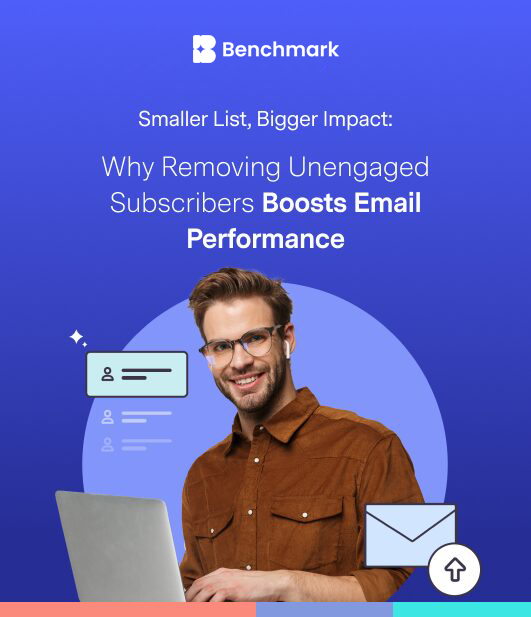
Smaller List, Bigger Impact: Why Removing Unengaged Subscribers Boosts Email Performance
DOWNLOAD NOW4. Engagement signals
Mailbox providers prioritize emails that people actually interact with.
Positive signals include opens, clicks, replies, forwarding, and adding your address to contacts. Negative signals include repeatedly ignoring emails, marking them as spam, or deleting without reading.
Segmentation improves engagement, and engagement improves deliverability.
5. Sending consistency
Sudden spikes in volume can trigger spam filters. Maintain a consistent sending cadence, gradually warm up new domains, and avoid unpredictable bulk spikes. Consistency builds trust with inbox providers.
Common email deliverability myths
Myth #1: “If It Was Sent, It Was Delivered.” False. Emails can be delivered to spam folders. Inbox placement is what matters.
Myth #2: “Subject Lines Are the Main Deliverability Factor.” While spammy language can hurt performance, engagement, and authentication matter far more than individual words. Deliverability is behavioral, not just textual.
Myth #3: “More Emails = More Revenue.” Over-sending leads to fatigue, lower engagement, and reputation damage. Relevance beats frequency.
How to improve email deliverability in 2026
Step 1: Authenticate Your Domain. Ensure SPF, DKIM, and DMARC are correctly configured. This is foundational. If you’re unsure, your email platform or IT team can assist.
Step 2: Clean Your Contact List. Regularly remove hard bounces, identify and re-engage inactive subscribers, and suppress non-responsive contacts. Protecting list health protects your sender reputation.
If your bounce rate climbs above 2%, it’s time to clean your list and remove addresses that are no longer active.
Step 3: Segment by Engagement. Instead of sending to everyone, create segments such as “engaged in the last 60 days,” “opened 3 of last 5 emails,” or “inactive for 120+ days.” Sending primarily to engaged subscribers improves reputation signals.
Step 4: Monitor Complaint Rates. Spam complaints should stay below 0.1% whenever possible. If complaints increase, reevaluate the frequency, clarify expectations at sign-up, and make unsubscribe links easy to find. A visible unsubscribe link reduces spam reports.
Step 5: Optimize for Value. The best deliverability strategy isn’t technical; it’s relevance. Ask: Is this email useful? Is this audience expecting it? Does it align with subscriber intent? High-value emails generate engagement, and engagement protects deliverability.
Getting past spam filters
To ensure your emails bypass spam filters, follow these best practices:
- Professional Design: Include valid contact information in every footer.
- Content Ratio: Maintain a balance of 40% images to 60% text.
- Subject Lines: Keep them clear, concise, and relevant.
- Compliance: Adhere to standard email marketing rules and regulations to avoid being flagged for “shady” practices.
Deliverability vs. open rates
Open rates reflect performance. Deliverability reflects access. You can’t improve open rates if your emails aren’t reaching inboxes, but strong segmentation and personalization improve both simultaneously.
Average open rates across industries hover around 19-20%, with higher rates seen in well-segmented campaigns. That engagement reinforces sender reputation, creating a positive cycle that benefits long-term deliverability.
Warning signs of deliverability problems
Watch for:
- Sudden drop in open rates
- Increase in spam complaints
- Rising bounce rates
- Large engagement declines
- Increased spam folder placement
If performance changes abruptly, investigate your authentication setup, recent list imports, and any changes in sending frequency. Deliverability issues rarely appear at random; they follow shifts in behavior.
The future of email deliverability
Deliverability is increasingly tied to domain reputation, engagement history, behavioral signals, and AI-driven spam filtering. The direction is clear: mailbox providers reward relevance and punish indiscriminate sending.
The marketers who win are those who maintain clean data, segment thoughtfully, send consistently, and provide genuine value. Technical setup matters, but strategy matters more.
Final thoughts
Email deliverability isn’t a single setting you toggle on. It’s an ongoing discipline. When you authenticate properly, maintain list hygiene, segment by engagement, send consistently, and prioritize relevance, you protect your inbox placement.
Here’s the bottom line: if your emails aren’t making it to the inbox, nothing else matters. Build your deliverability foundation carefully, and everything else becomes possible.
Frequently Asked Questions
What Is Email Deliverability?
Email deliverability is the chance your message lands in the inbox, not the spam or junk folder, after the mailbox provider accepts it. That differs from email delivery, which only confirms the server received your message. Good deliverability depends on a verified sending domain with SPF, DKIM, and DMARC in place, clean permission-based contact lists, a strong sender reputation, and engaging content that keeps subscribers opening and clicking.
What Is a Good Email Deliverability Rate?
A healthy target is 95% or higher of your emails reaching the inbox. Keep these guideposts in mind: bounce rate under 2%, spam complaint rate under 0.1%, and unsubscribe rate under 0.5%. Staying in these ranges signals to inbox providers that you’re a trusted sender.
How Can I Check My Email Deliverability?
Use a quick three-step check:
- Review your Benchmark Email reports for bounces, spam complaints, and open rates.
- Send a test campaign to accounts on Gmail, Outlook, and Yahoo to see where it lands.
- Run your domain through tools like Google Postmaster Tools, Sender Score, or MXToolbox to spot blocklist or authentication issues.
Track these numbers after every send and investigate any sudden drops.
What’s the Difference Between Email Delivery and Email Deliverability?
Email delivery means the receiving server accepted your message. Email deliverability means the message reached the inbox rather than spam or another folder. You need both, but only great deliverability drives opens and clicks.
About the Author:

Content Marketing Manager | Content marketing, inbound funnel, social media, email nurture | Natalie Slyman is an experienced Content Marketing Manager at Benchmark Email with a strong B2B background and a knack for crafting pillar content that boosts SEO and brand authority. She regularly shares actionable insights—from remote-work strategies to AI-powered content workflows—via blog posts and webinars tailored for busy marketers.

A powerfully simple email marketing platform
Sign up for free to see how effortless email marketing can be.
Our Company
Compare
Solutions
Compare
Account
© Polaris Software, LLC Benchmark Email® is a registered trademark of Polaris Software, LLC
© Polaris Software, LLC
Benchmark Email® is a registered trademark of Polaris Software, LLC