


7 Best Constant Contact Alternatives to Consider in 2026

Constant Contact has been around forever, and for good reason. It’s helped tons of businesses send emails and connect with their audiences. But here’s the thing: just because something’s been around doesn’t mean it’s still the best fit. However, as the marketing landscape evolves and businesses seek more diverse options, it’s important to explore alternative email marketing solutions that offer unique features and capabilities.
In this guide, we’ll break down the top Constant Contact alternatives, explain what sets them apart, and identify which one might actually fit your needs. Whether you need something cheaper, more automated, or just easier to use, there’s probably a better option out there for you. Join us as we explore these alternatives, empowering you to make an informed decision and discover the perfect email marketing solution to drive your business forward.
The value of email marketing
But first, why does email marketing still matter so much? Here’s the short version:
- Direct and Personal Communication: Email lands right in your subscribers’ inboxes; no algorithm, no middleman. You can tailor messages to specific people and actually reach them.
- Targeted and Segmented Campaigns: With email marketing, you can segment your audience by demographics, interests, purchase history, or engagement levels. This segmentation allows you to tailor your messages and offers to specific groups, ensuring relevance and increasing the chances of engagement and conversion. By sending targeted campaigns, you can deliver the right content to the right people at the right time.
- Efficiency: Email marketing platforms offer features that streamline and automate various aspects of your campaigns. You can set up welcome emails, abandoned cart reminders, or post-purchase follow-ups. This saves time and effort while ensuring consistent and timely communication with your subscribers.
- Cost-Effective Marketing Channel: Email is way cheaper than print ads or direct mail. No printing, no postage. Just you, your message, and your audience.
- Increased Engagement and Conversions: Email marketing is an effective channel to engage your audience and drive conversions. By delivering valuable content, personalized offers, and exclusive discounts, you can capture your subscribers’ attention and motivate them to take action. Whether it’s making a purchase, signing up for a webinar, or downloading a resource, email campaigns can drive meaningful conversions and revenue.
- Relationship Building and Customer Loyalty: Regular email communication helps you build and nurture relationships with your audience. By consistently delivering valuable and relevant content, you can establish trust, showcase your expertise, and position your brand as a reliable resource. This relationship-building aspect fosters customer loyalty, leading to repeat business, referrals, and long-term customer relationships.
- Data-Driven Insights and Optimization: Email marketing provides valuable data and insights about your audience’s behavior, preferences, and engagement levels. By analyzing email metrics like open rates, click-through rates, and conversion rates, you can gain insights into what works and what doesn’t. This data-driven approach enables you to refine your email marketing strategies, optimize your campaigns, and continuously improve your results.
- Integration with Other Marketing Channels: Email marketing integrates well with other marketing channels, amplifying your overall marketing efforts. You can promote your social media profiles, blog posts, or website content through email campaigns to drive traffic and engagement. Additionally, by incorporating email sign-up forms on your website or landing pages, you can grow your email list and expand your reach.
Why consider Constant Contact Alternatives?
Here’s the short answer: most marketers switch because they want lower pricing, better automation, and designs that don’t look like they’re from 2015. When it comes to switching from Constant Contact, reasoning can include:
- High pricing for limited features: Many users find Constant Contact expensive compared to newer platforms with more advanced capabilities.
- Limited automation options: Basic workflows can feel restrictive for marketers who want more sophisticated automation.
- Outdated email editor experience: Some users report that the editor feels less modern or flexible than newer tools.
- Segmentation limitations: Advanced targeting and behavioral segmentation can be harder to implement.
- Reporting depth: Analytics and attribution options are relatively basic compared to modern marketing platforms.
- Scaling challenges: As lists grow, pricing increases quickly without a proportional increase in functionality.
- Desire for newer AI tools: Many marketers want AI-assisted design, copy, and optimization features that older platforms lack.
7 best alternatives to Constant Contact
There are several email marketing alternatives to Constant Contact that offer a variety of features and capabilities. Here are a few popular options worth considering:
1. Benchmark Email – for busy marketing teams who need simplicity.

If you’re looking for a Constant Contact alternative to make email marketing feel easier, not heavier, Benchmark Email might be exactly what you need. Instead of trying to be everything at once, Benchmark focuses on getting core email right:
- Fast, intuitive drag-and-drop builder
- Built-in segmentation without spreadsheet exports
- Reporting that highlights clear next steps
- Transparent, contact-based pricing
- AI-powered content polishing tools
Why teams choose Benchmark Email
Many marketers don’t struggle because they lack automation. They struggle because:
- Campaign setup takes too long
- Contact lists feel disorganized
- Reporting feels confusing
- The tool itself feels overwhelming
Benchmark was built to reduce that friction. Automation is powerful, and on the roadmap, but not at the expense of clarity, speed, or simplicity.
Performance snapshot
According to Benchmark’s 2026 Email Marketing Benchmarks Report, the average open rate across industries is approximately 25.55%, and plenty of mid-sized businesses are beating that. Relevance and segmentation consistently drive performance improvements.
Best for: Marketing managers, small- to mid-sized businesses, and teams who want email to be the easiest part of their day.
2. Mailchimp – for brand recognition and a broad ecosystem
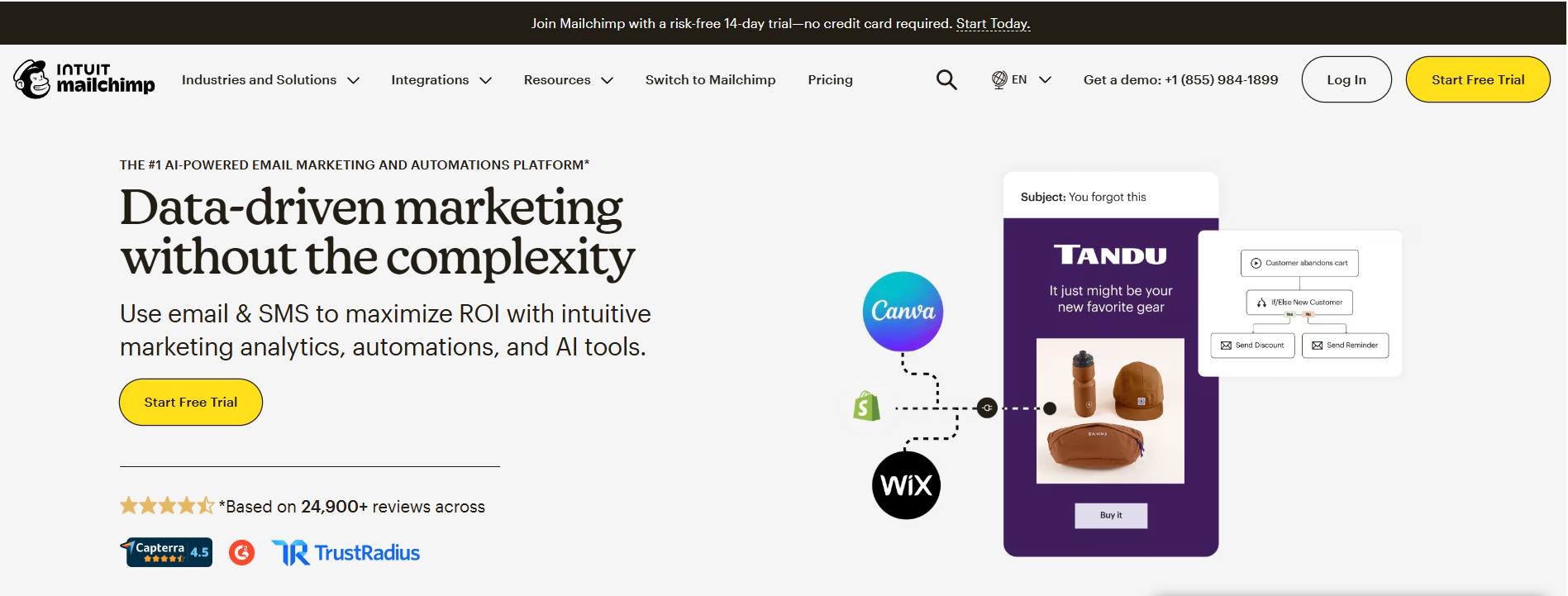
Mailchimp is one of the most recognizable names in email marketing. It offers:
- Automation workflows
- Landing pages
- Social posting tools
- Built-in CRM features
The catch? Pricing jumps fast as your list grows, and the interface has gotten more complicated over time.
Best for: Teams looking for a broad marketing ecosystem under one brand.
3. Brevo (formerly Sendinblue) – for multi-channel messaging
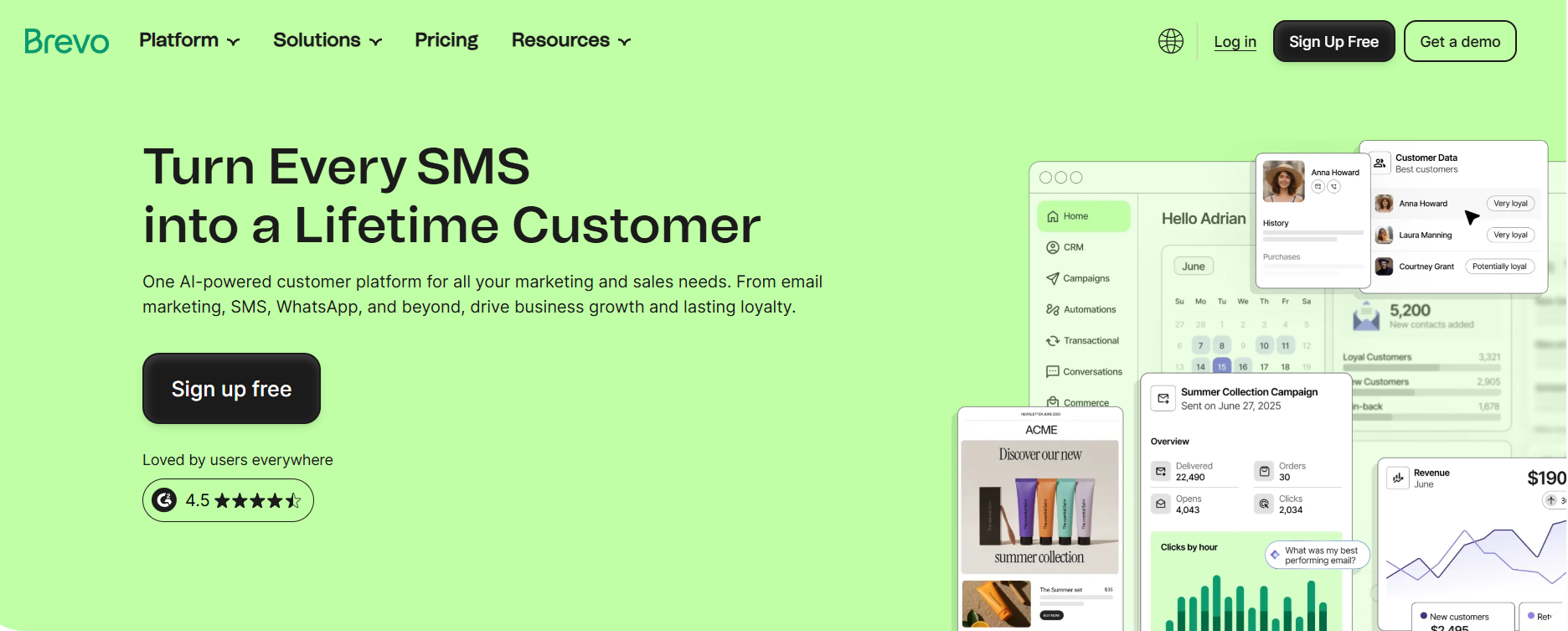
Brevo combines email, SMS, chat, and CRM functionality into one platform. It’s attractive for teams who want multi-channel messaging in a single dashboard. However, like many all-in-one platforms, added breadth can mean added complexity.
Best for: Businesses want integrated SMS and transactional messaging alongside email.
4. ActiveCampaign – for advanced automation

ActiveCampaign is known for its powerful automation capabilities and CRM integrations. You can build highly complex customer journeys with layered logic. The trade-off? A steeper learning curve.
Best for: Sales-driven teams and businesses are ready to invest time in building advanced automation systems.
5. AWeber – simplicity for solopreneurs

AWeber has long catered to entrepreneurs and small businesses. It offers:
- Basic automation
- Templates
- Straightforward email building
It’s less complex than enterprise tools but may lack some of the refinement of newer platforms.
Best for: Solopreneurs and very small teams.
6. GetResponse – strong webinar and funnel tools

GetResponse combines email marketing with:
- Funnel builders
- Webinar hosting
- Landing pages
For teams focused heavily on online course sales or webinars, this bundled approach can be attractive. However, like other bundled platforms, the breadth of tools may not suit teams that only want email.
Best for: Education, info-product, and webinar-focused businesses.
7. HubSpot – full CRM ecosystem
HubSpot is a comprehensive CRM and marketing platform with robust email capabilities. It integrates deeply across sales, marketing, and service functions. But it comes at a significantly higher price point and complexity level.
Best for: Large organizations want full-funnel CRM alignment.
How to choose the right Constant Contact alternative
When comparing email marketing platforms like Constant Contact, don’t just look at features. Ask yourself:
- How much time do I realistically spend on email each week?
- Do I need advanced automation right now?
- Is my biggest challenge complexity or strategy?
- Do I want more tools — or fewer obstacles?
If email is only part of your job, a streamlined platform often produces better outcomes than a feature-heavy system. Because when tools are intuitive, teams send more consistently. And consistency drives results.
The hidden cost of feature overload
Many marketers assume that more features equal better performance. But more features can mean:
- More tabs
- More configuration
- More decision fatigue
- More onboarding time
If your platform feels like a second job, it may be time to simplify. That’s why many teams evaluating alternatives to Constant Contact prioritize clarity, speed, and ease of use.
Final thoughts
Constant Contact remains a long-standing option in the email marketing space. But in 2026, businesses will have more choices than ever.
The best Constant Contact alternative depends on your goals:
- Want advanced automation? ActiveCampaign may fit.
- Need multi-channel tools? Brevo could work.
- Looking for a CRM ecosystem? HubSpot might make sense.
- Want email marketing that feels simple, intuitive, and efficient? Benchmark Email was built for that.
At the end of the day, email marketing shouldn’t feel overwhelming. It should feel manageable.

Sign up for a free Benchmark Email account today!
SIGN UP FREEFrequently asked questions
Why do businesses look for alternatives to Constant Contact?
Costs can climb fast as your list grows. There are also limits with automation, stale templates, and a lack of reporting depth.
How can I move my contacts and email templates from Constant Contact to another platform?
You will need to export your entire contact list from Constant Contact, most likely as a CSV file, and import it into your new platform. When doing so, keep in mind you’ll want to import the right information, i.e., first name, last name, email, etc.
Will I lose my automations when I switch email platforms?
Yes. You can use your Constant Contact flows as inspiration and direction for your new flows in your new platform, but they will need to be recreated.
What features should I compare when picking a new email marketing tool?
I recommend comparing the following:
- Pricing
- Automation
- Segmentation
- Templates
- Deliverability
- Reporting
- Contact management
Can switching email providers help lower my monthly costs as my list grows?
It depends. Make sure you compare per-subscriber pricing at projected list sizes to determine any cost changes.
Will switching email platforms hurt my deliverability?
No, not as long as you warm up your domain properly and keep your list clean and up to date.
About the Author:

High level marketing, technical email topics, email trends | Jessica Lunk is the VP of Growth Marketing at Benchmark Email, where she combines strategic flair with hands-on expertise to help busy marketers elevate their email game. Delivering timely insights on list hygiene, ROI, and email deliverability, she’s a go-to voice for practical marketing wisdom.

A powerfully simple email marketing platform
Sign up for free to see how effortless email marketing can be.
Our Company
Compare
Solutions
Compare
Account
© Polaris Software, LLC Benchmark Email® is a registered trademark of Polaris Software, LLC
© Polaris Software, LLC
Benchmark Email® is a registered trademark of Polaris Software, LLC