


7 Best Email Newsletter Examples That Drive Clicks and Why They Work
Key Takeaways
- Earn attention before you ask for action. Every high-performing newsletter in this roundup leads with value, whether that’s a story, social proof, a quiz, or editorial content, before presenting a CTA. The click is a byproduct of trust, not pressure.
- Visual hierarchy is a conversion tool. Scannable layouts, bold imagery, and clear section structure allow readers to self-select into what interests them, rather than forcing them to work through a wall of copy.
- Social proof works best when it’s aspirational. Testimonials and speaker lineups aren’t just signals of credibility; they help readers see themselves in the outcome. Names, titles, and recognizable brands do more work than generic star ratings.
- Narrative-driven copy outperforms feature-driven copy. Emails that open with a relatable scenario, a real customer story, or a compelling question create emotional buy-in before the product ever appears.
- Interactivity drives long-term engagement, not just one-time clicks. Recurring formats like weekly quizzes train subscribers to anticipate your emails, compounding engagement over time.
- Great CTAs reframe, not just repeat. Using progressively warmer or contextually distinct CTA language gives hesitant readers multiple entry points to the same action.
- Transparency builds brand equity. Whether it’s explaining a rebrand or creating urgency rooted in a real trend, honesty resonates and converts more reliably than manufactured pressure.
Most marketing emails(opens in new tab) get ignored. The average open rate(opens in new tab) (opens in new tab)(opens in new tab)(opens in new tab) varies widely across industries, and click-through rates tend to remain low overall.
So when a newsletter consistently outperforms typical engagement levels, it’s worth asking: what exactly are they doing differently?
We collected some of the best newsletter examples and broke down the specific design, copy, and structural choices that make each one effective.
Email Newsletter Importance
Just one word – consistency.
Consistent contact with existing or potential customers is a major step toward conversion.
Your end-goal doesn’t matter much here. It can be a better manual backlink strategy(opens in new tab), obtaining more followers, or sharing event information with subscribers. Whatever you do, an email newsletter and consistent contact with your leads are a must.
Now, here are some of the best examples that’ll drive those clicks for you!
1. The Content-First Gaming Digest
The best gaming newsletters don’t sell. They inform first, sell second.
Xbox’s newsletter(opens in new tab) is a masterclass in editorial pacing. It opens with a splashy Minecraft seasonal takeover, before settling into a clean, structured feed of new releases, game updates, community spotlights, and savings.
Nothing about it feels like a pitch, even though every section has a CTA.
Why Xbox is winning in email design(opens in new tab):
- Visual hierarchy: Each section features a bold banner image followed by short copy, no more than 2 sentences per game. Readers can scan the whole email in under 20 seconds, then click into whatever interests them—density without clutter.
- Section variety: The email traverses distinct sections. New Games → Game Updates → Community → Savings Spotlight. This content rhythm gives different reader types multiple reasons to stay engaged through the footer discount.
- Brand consistency(opens in new tab): Every color, badge, and layout choice maps directly to the Xbox brand system. Subscribers know at a glance who sent this. Trust is built before the first word is read.
2. The Social-Proof Powered Course Pitch
Real testimonials from people like your reader are more persuasive than any headline you’ll ever write.
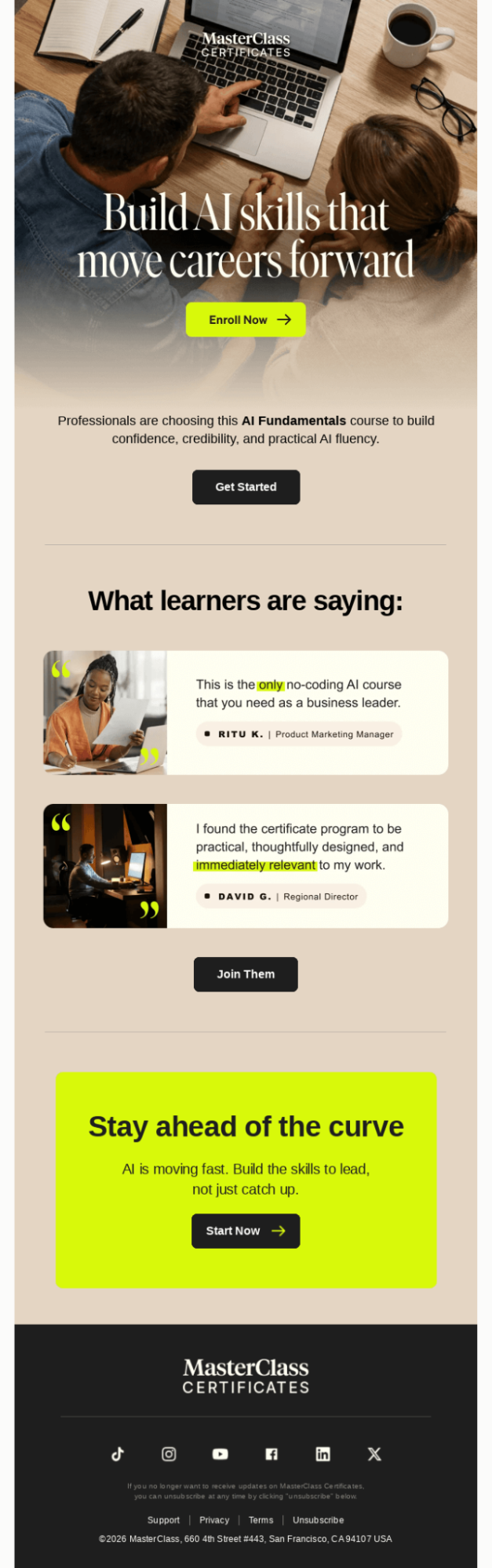
MasterClass Certificates keeps this email tight: a striking hero image, a two–sentence value proposition, two testimonials, and three CTAs. That’s it. No noise. The design leans into a muted editorial beige palette that feels premium, a smart choice for a product that sells professional credibility.
(Image source(opens in new tab))
How this email stays ahead of the curve:
- Social proof(opens in new tab) placement: Testimonials from Ritu K. (Product Marketing Manager) and David G. (Regional Director) aren’t just quotes. They’re aspirational identity signals. Readers see their career level and think, “That could be me.” Names + titles do more work than logos or star ratings.
- CTA strategy: Three calls to action, “Enroll Now,” “Get Started,” “Join Them,” use progressively warmer language. Each one reframes the same action differently, so the reader who didn’t click the first time might respond to the third framing.
- Urgency without pressure: The closing block, “AI is moving fast. Build the skills to lead, not just catch up,” creates urgency rooted in a real trend rather than artificial scarcity. It’s honest, and that’s why it lands.
While some newsletters rely on social proof to drive conversions, others take a different approach, leading with narrative.
3. The Story-Driven Product Launch Email
Sell the story, and the product sells itself.
Marsh Hen Mill, a Southern grain mill, uses the email to launch new merchandise without ever sounding like a sales email.
It opens with a question: “You know that one shirt you always pull from the rack on a Monday?” That’s a hook built on personal recognition, not product specs.

(Image source(opens in new tab))
By the time you reach the product grid, you already want to own one of these shirts.
This email’s major selling points:
- Conversational opening: The email lands with a relatable scenario (favorite shirts, getting dressed, feeling ready) before introducing the product. Empathy before pitch is one of the oldest copywriting principles, and Marsh Hen executes it cleanly.
- Grid layout: A 2×3 product grid with named items and a single “Take Them Home” button keeps choices manageable. Six products are the sweet spot: enough variety without triggering decision fatigue.
- Category cross-sell: The bottom “Shop By Category” section (Grits, Grains, Rice, Cornmeal, Bundles, Merch) reminds food buyers about the apparel and vice versa, a subtle but effective cross-sell that boosts average order value without extra copy.
4. The Event Announcement That Builds FOMO
The best event emails(opens in new tab) make you feel like you’d be missing out on a cultural moment, not just a conference.
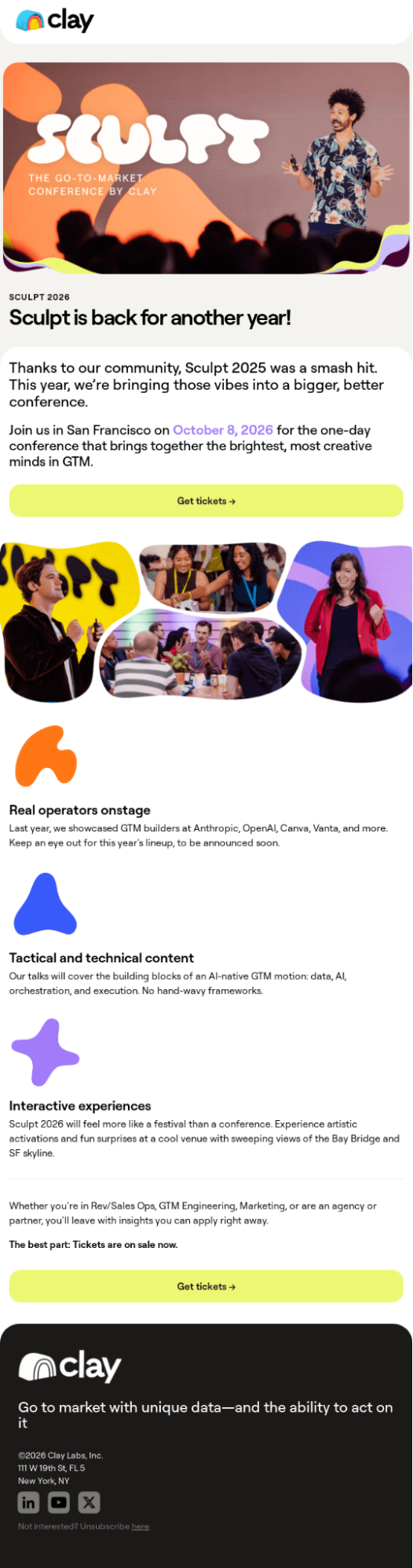
Clay’s Sculpt 202 announcement is visually bold: warm stage photography, colorful blob shapes as section dividers, and a deliberately festival-adjacent tone.
(Image source(opens in new tab))
The email doesn’t just announce a conference. It positions the event as an experience. That framing shift is what drives early ticket urgency(opens in new tab).
Here’s why this email works:
- Proof by association: Mentioning Anthropic, OpenAI, Canva, and Vanta as last year’s speakers does serious credibility work. Name recognition borrowed from top-tier companies raises the perceived value of attending before a single agenda item is announced.
- Three-pillar structure: The email breaks value into three concrete pillars: Real operators onstage, Tactical content, and Interactive experiences. There is a cognitive sweet spot. It’s memorable, scannable, and feels complete without overwhelming.
- Audience inclusion: The line “Whether you’re in Rev/Sales Ops, GTM Engineering, or an agency” explicitly names the reader’s possible role. People are more likely to click when they feel like you’re personally addressing them than they are to click if you’re speaking to them as a generic audience.
5. The Customer Story That Drives High-Intent Clicks
Show the outcome first. The product earns attention on its own.
This email from Alan’s Factory Outlet is a prime example of how it masterfully uses the “Customer Success Story” model to generate high-intent clicks.
The subject line(opens in new tab) and headline immediately grab the reader’s attention with a compelling and relatable story about “Terry,” who used the company’s tools to rebuild his home smarter and stronger after the disaster.
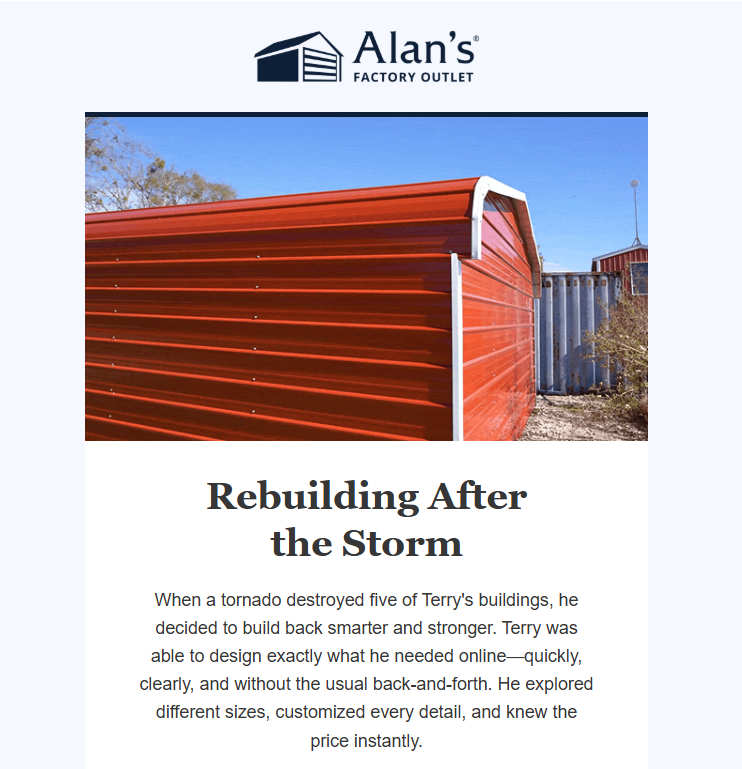
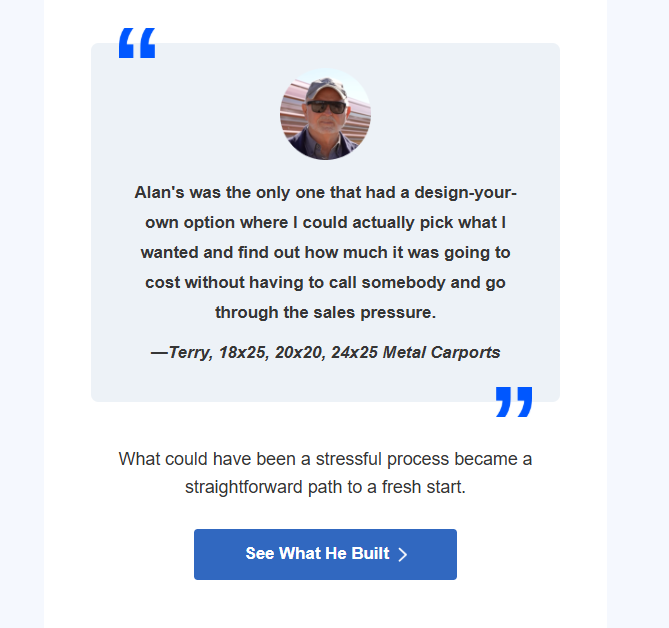
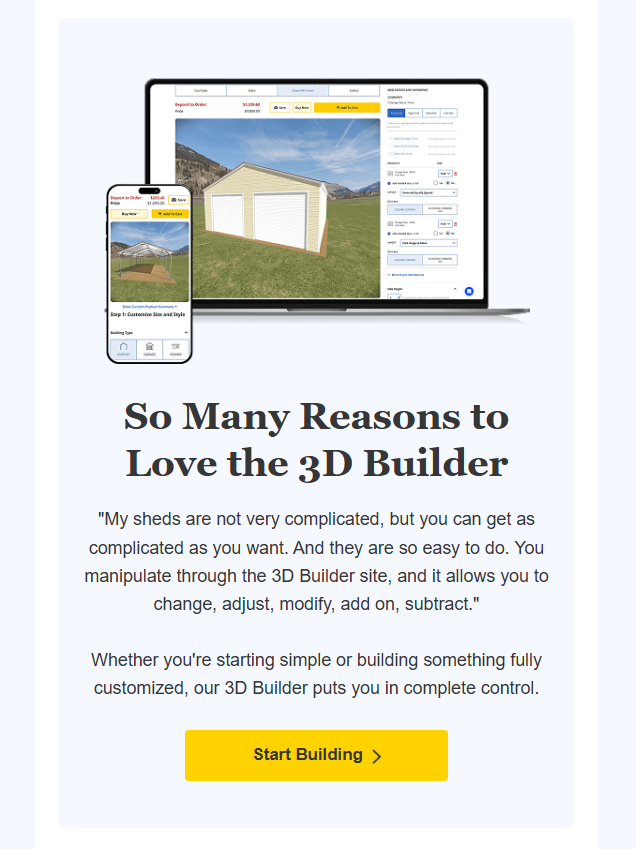
It features a “3D Builder” tool Terry mentions, which lets him design his own metal building(opens in new tab) and see pricing instantly, without sales pressure. This makes it easy for potential buyers to access the information.
Additionally, the email includes a link to their YouTube channel, where customers can find DIY project inspiration and incentives for user-generated content (UGC).
Why this is one of the best email newsletter(opens in new tab) examples:
- Narrative-led trust: The email opens with a real rebuilding story, which creates credibility and emotional pull before introducing any product details.
- Interactive next step: Highlighting the ability to design a custom metal building gives readers a clear, hands-on way to engage rather than just read.
- Friction reduction: Seeing designs and pricing upfront removes hesitation and moves readers closer to action without a hard sell.
6. The Interactive Quiz That Builds Ongoing Engagement
Give readers something to do, and they’ll keep coming back.
Beaches of Normandy offers a perfect example of how to create a newsletter heavily focused on conversion. It doesn’t just sit in the inbox; it invites the subscriber to participate(opens in new tab). Despite having a simpler structure than typical newsletters, the Beaches of Normandy newsletter also qualifies as one.
Contrary to what many brands do by sending one-off promotions, this email demonstrates that it’s part of a broader, ongoing communication strategy through sequential numbering, which immediately indicates a regular and recurring series:
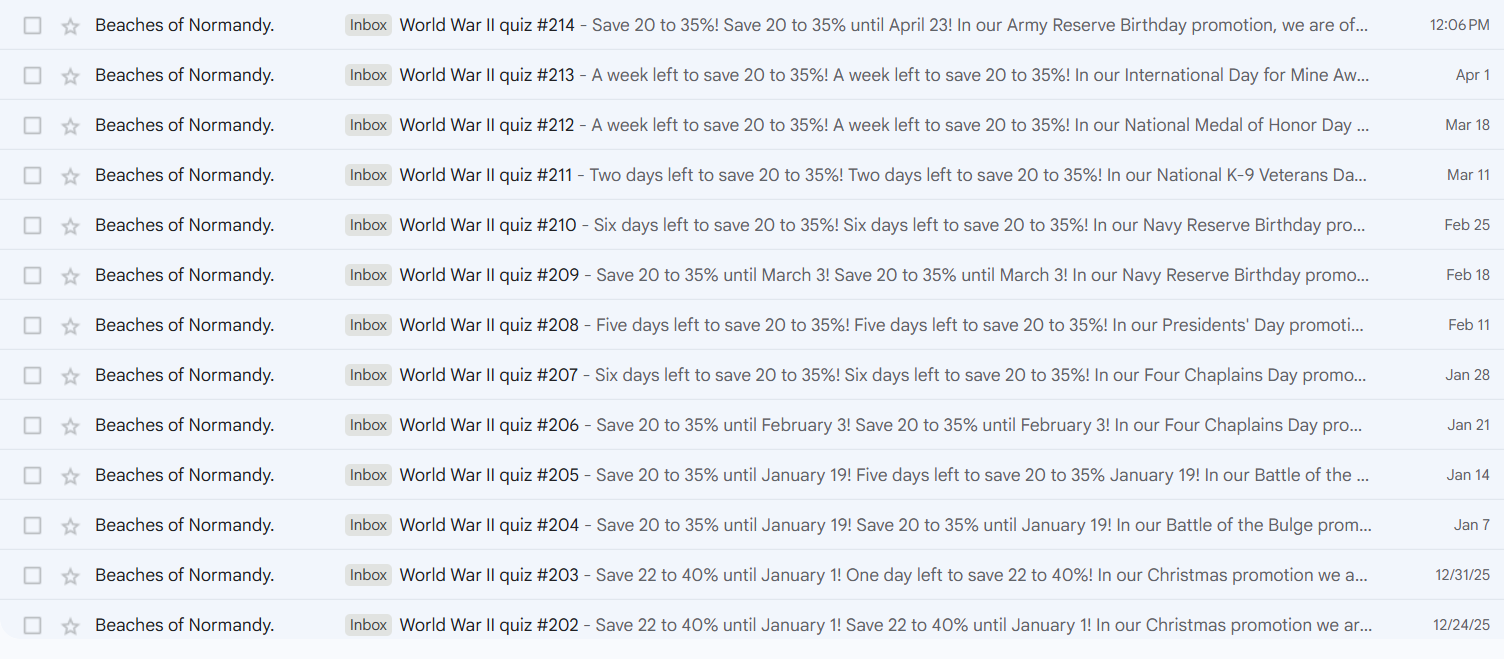
The text reinforces this idea by noting that they publish a new quiz every week, thereby establishing a regular starting point for subscribers.
Furthermore, rather than a simple invitation to “buy a tour,” the main focus is a quiz for history buffs, offering them the chance to test their knowledge of World War II sites in Italy(opens in new tab), Germany, France, and other countries. This is a classic newsletter tactic: providing intrinsic value first and foremost to keep the audience engaged with the brand over the long term.
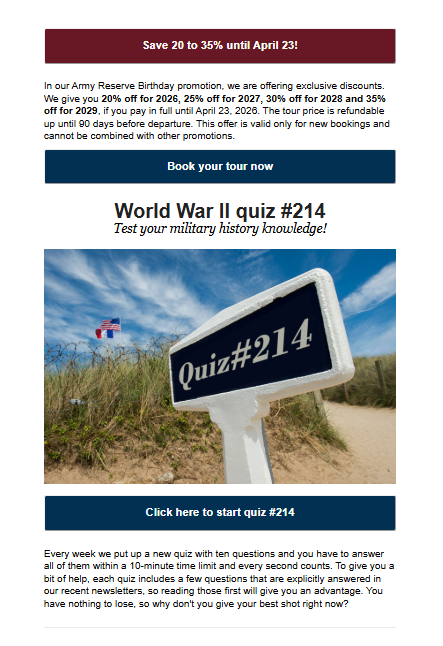
What this email newsletter gets right:
- Habit creation: A recurring quiz format trains subscribers to expect and look for each email, increasing long-term engagement.
- Curiosity-driven entry: Centering the content on World War II sites in Italy draws readers in with interest rather than a pitch.
- Seamless conversion path: After engaging, exploring the Italian Campaign Tour feels like a natural next step rather than a sales pitch.
7. The Rebrand Announcement Done Right
A rebrand email is really a trust email. Explain the ‘why’ before you ask for the ‘what.’
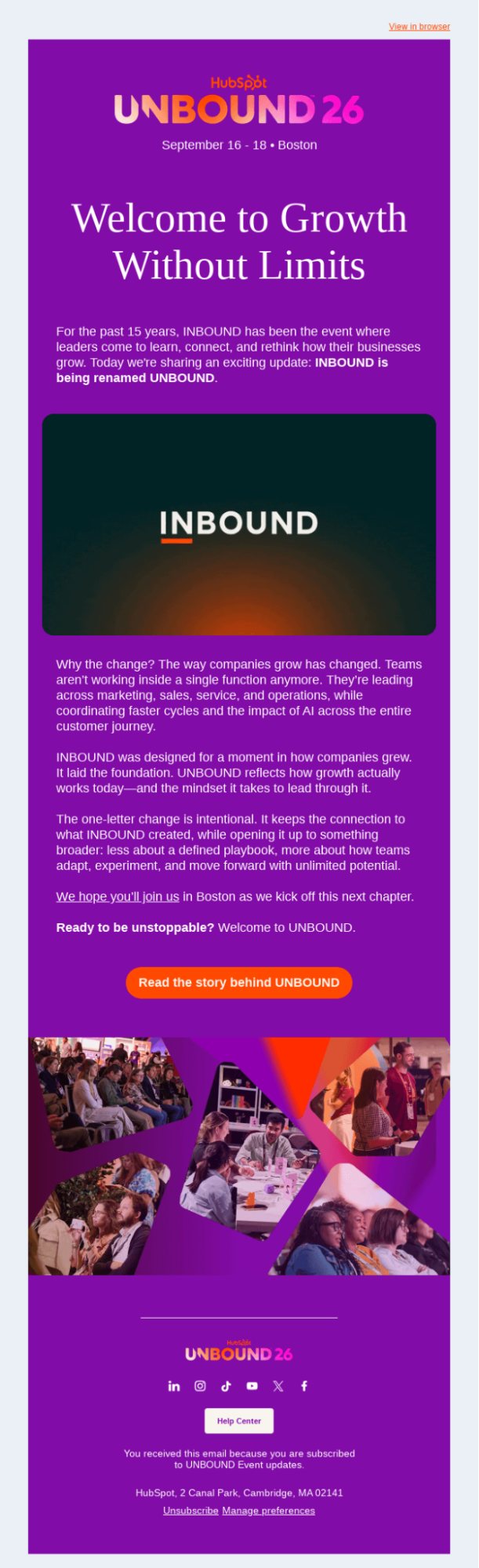
INBOUND becoming UNBOUND is a one-letter change, and HubSpot knew it needed that careful explanation.
(Image source(opens in new tab))
The email is structured almost like a brand manifesto. It leads with 15 years of history, explains why the world has changed, and then makes the case that the new name reflects how growth actually works today.
Only then does it ask you to buy tickets.
Need more convincing that this is one of the best email newsletter examples? Here’s what makes it stand out:
- Bold color commitment: The full-bleed violet-and-orange palette is aggressive, and intentionally so. High visual contrast in the inbox signals confidence. You know who sent this before you read the subject line.
- Narrative arc: The email follows a classic story structure: past → problem → resolution → call to action. Copy that tells a story has a lower cognitive load than bullet point lists. Readers absorb it more quickly and feel more connected to the brand afterward.
- Closing punch: “Ready to be unstoppable? Welcome to UNBOUND.” is a two-sentence close that combines an identity statement with an invitation. Endings that make the reader feel something are what turn passive readers into clickers.
Good Emails Don’t Happen By Accident
None of these emails leads with a hard sell. Every one of them earns attention first. They do that through story, structure, social proof, or sheer visual confidence.
They let the click happen naturally.
Take one thing from each example and test it in your next send.
Ready to put these ideas into practice? Create a free Benchmark Email account(opens in new tab) and start building campaigns that actually get clicked.

Sign up for a free Benchmark Email account today!
SIGN UP FREE
Frequently Asked Questions
What makes an email newsletter effective at driving clicks?
The most consistently effective newsletters prioritize earning attention before asking for action. That means leading with genuine value, like editorial content, a compelling story, social proof, or an interactive element, rather than opening with a hard sell. Structural clarity, strong visual hierarchy, and a singular, well-framed CTA handle the rest.
How many CTAs should a newsletter include?
It depends on the email’s objective, but the best-performing examples in this roundup range from 1 to 3 CTAs, and even when multiple CTAs appear, they each reframe the same action rather than compete for different outcomes. More than three typically dilutes focus and reduces overall click-through rates.
How important is visual design compared to copy in email newsletters?
Both matter, but they serve different functions. Design earns the first few seconds with a strong visual hierarchy, brand-consistent imagery, and scannable layouts that keep readers from bouncing. Copy earns the click. The most effective newsletters use design to guide attention and copy to build the case for action.
Can smaller brands replicate what large brands like Xbox or MasterClass are doing?
Absolutely. The underlying principles, like editorial pacing, social proof, narrative-led copy, and clear structure, are format decisions, not budget decisions. Marsh Hen Mill, a regional grain mill, demonstrates this directly: their story-driven product launch outperforms many enterprise sends purely on the strength of its opening hook and empathetic framing.
What’s the best way to create urgency in an email without feeling manipulative?
Tie the urgency to something real. The MasterClass example works because its urgency, “AI is moving fast,” reflects a genuine market reality rather than an artificial countdown. Urgency grounded in a true trend, a limited inventory, or an actual deadline feels honest. Manufactured scarcity, by contrast, erodes subscriber trust over time.
How do interactive elements like quizzes improve newsletter performance?
Interactive content shifts the subscriber’s role from a passive reader to an active participant, increasing time-on-email and click-through rates in the short term. More importantly, recurring interactive formats, like a weekly quiz, create habitual engagement, training subscribers to anticipate and open each send. That kind of conditioned behavior is far more durable than any single campaign can produce.
How should a brand approach a major announcement, such as a rebrand, in email?
Lead with the “why” before you ask for anything. The HubSpot/INBOUND example is instructive: it spends the majority of the email establishing context, history, and rationale before presenting a ticket purchase CTA. Audiences are far more receptive to change and to action when they feel informed rather than surprised.
