


30 Successful Email Marketing Campaign Examples (+ What Makes Them Work)
Key Takeaways
- Segmentation and personalization are the common thread behind most high-performing campaigns.
- Every email has one job. The campaigns that perform best have a single, clear purpose and a single, clear CTA.
- Timing is strategy. Behavior-triggered emails consistently outperform scheduled batch sends.
- Subject lines and preview text matter as much as body copy. They determine whether the rest gets read at all.
- Post-click experience matters. A great email sent to a weak landing page wastes the open.
A great email marketing campaign doesn’t happen by accident. Behind every send that drives opens, clicks, and conversions is a deliberate combination of the right message, the right audience, and the right timing.
The examples below span welcome sequences, promotional campaigns, re-engagement sends, transactional emails, and more. What ties them together isn’t a single tactic. It’s the mindset behind them: every email has a specific job to do, and every element is designed to help it do that job.
Here’s what 30 successful email marketing campaigns have in common and what you can take from each.
Welcome campaigns
Welcome emails are among the highest-performing category in email marketing. Subscribers are most engaged the moment they join, and a strong welcome sequence capitalizes on that.
1. The Single-Send Welcome: A clean, on-brand email that delivers exactly what was promised at sign-up (a discount, a free resource, an introduction), then sets clear expectations for what’s coming next.
What to steal: Deliver value immediately. Don’t save it for later.
2. The Three-Email Welcome Series: Email 1: Your origin story and what subscribers can expect. Email 2: Your best content or most popular product. Email 3: A soft conversion ask.
What to steal: Spread the relationship across multiple sends instead of cramming everything into one.
3. The “Get to Know You” Welcome: Asks new subscribers a single preference question (via a link or reply) to segment them before sending further campaigns.
What to steal: Zero-party data collected early dramatically improves every future send.
4. The Community Welcome: Used by brands with strong communities (forums, Facebook groups, Slack communities), introduces the subscriber to the community, not just the brand.
What to steal: The hook isn’t always a product. Sometimes it’s belonging.
5. The Behavior-Based Welcome Variant: Sends different Welcome Email 1 depending on what the subscriber signed up through (blog sidebar vs. checkout opt-in vs. lead magnet).
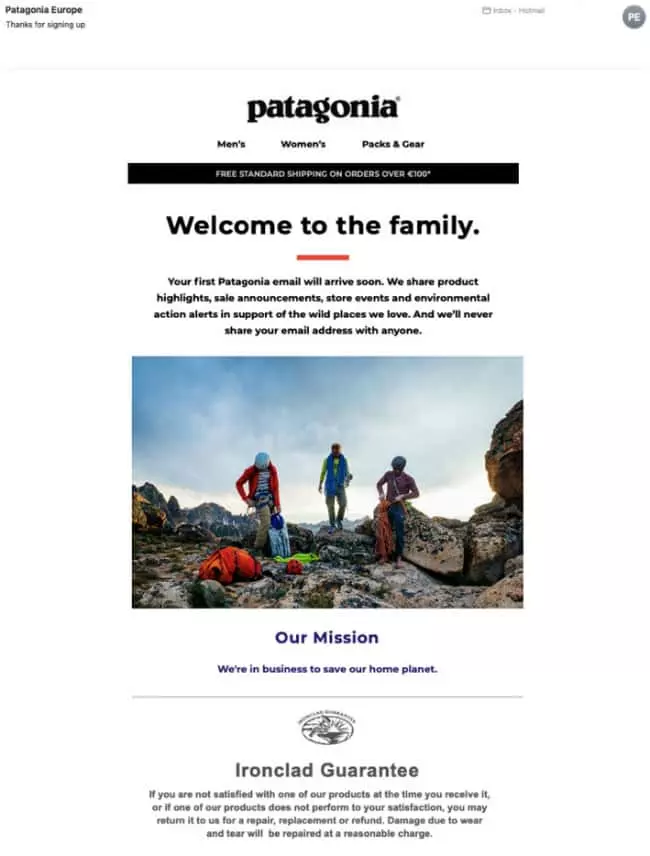
Patagonia shows us how to do the all-important welcome email right.
Community-building is an essential element of successful email marketing. When someone joins a newsletter, they should feel as if they’re becoming part of an exclusive club. This reduces the likelihood of unsubscribing and creates a stronger sense of value, especially when tied to community-based offers and incentives.
Note how they offer a warm welcome, explain the newsletter’s nature, and reaffirm privacy before diving into brand- and product-related info in that order.
Promotional campaigns
6. The Time-Limited Sale Announcement: A clean, single-purpose email announcing a sale with a countdown timer and one CTA. No other content, no distractions.
What to steal: Urgency and simplicity work together. Don’t dilute a promotional email with editorial content.
7. The Early Access Email: Sent to your most engaged subscribers before a sale opens to everyone. Rewards loyalty and generates buzz.
What to steal: Segmenting your best subscribers for early access builds loyalty and outperforms blanket promotions.
8. The Product Launch Sequence A three-to-five email series building anticipation before launch: teaser → reveal → benefit deep-dive → launch day → last chance.
What to steal: Sequences consistently outperform single sends for high-stakes launches.
9. The Cart Abandonment Email: Automatically triggered when a subscriber adds something to their cart but doesn’t complete the purchase. One of the highest-ROI automations in eCommerce.
What to steal: The timing matters as much as the message. Most cart abandonment emails perform best within one to three hours.
10. The Browse Abandonment Email: A gentler version of cart abandonment, triggered when someone views a product but doesn’t add to cart. Works best with a “still thinking about it?” subject line.
What to steal: Not every trigger requires urgency. Sometimes curiosity is the right tone.
11. The Back-in-Stock Notification: Sent to subscribers who opted in to be notified when an out-of-stock item returns. Extremely high open and click rates because the subscriber requested it.
What to steal: Email that arrives because the subscriber asked for it is the highest-performing category. Create more of these moments.
12. The Bundle Offer Email: Promotes a curated bundle at a price point lower than the components individually. Increases average order value and simplifies decision-making.
What to steal: Bundles reduce friction by making the “which combination?” decision for the customer.
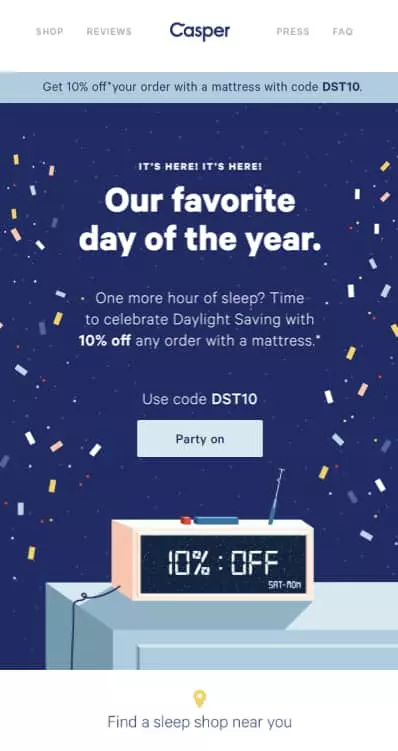
See Casper’s email as a solid promotional email example.
10% off a $2000 mattress is a considerable amount of money, and those who joined Casper’s newsletter are well aware of that.
That’s why they chose an incentive-heavy approach for this email. See how they’ve bolded their 10% offer in the body text, integrated it into the visual design with the alarm clock, and featured the discount code itself alongside a CTA button for silky-smooth conversions.
If you’re offering a coupon, consider combining your email with a limited-time retargeting campaign. This is a lot easier if you use trackable links in your emails.
Retention and loyalty campaigns
13. The Post-Purchase Check-In: Sent a few days after delivery. Asks how the product is working, offers a tip for getting the most from it, or provides a relevant how-to resource.
What to steal: Post-purchase emails are dramatically underused. They build loyalty and reduce returns.
14. The Loyalty Program Update: Tells subscribers where they stand in a loyalty program, points balance, status, and what they’re close to earning.
What to steal: Progress updates motivate action. The closer someone is to a threshold, the more effective the email.
15. The VIP Exclusive Email: Sent only to top-tier customers: a special offer, early access, or invitation that signals their status.
What to steal: Exclusivity increases perceived value. “This is just for you” outperforms “this is for everyone.”
16. The Anniversary Email: Triggered on a subscriber’s one-year (or multi-year) anniversary as a customer or subscriber.
What to steal: Marking milestones in a customer relationship shows you’re paying attention. It’s personal without requiring deep personalization.
17. The “Thank You” Email: Sent simply to thank subscribers for being part of your community, no ask, no promotion, just appreciation.
What to steal: Occasional emails that give without asking build trust, making future promotional sends more effective.
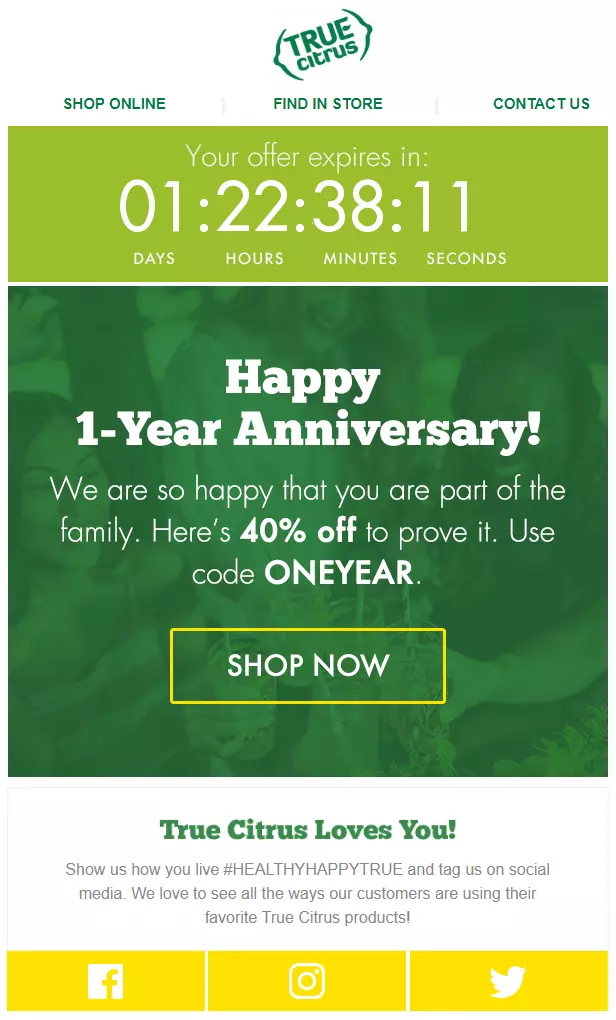
True Citrus has integrated an active countdown timer into their milestone email, which marks the offer’s expiry date and creates a sense of urgency for the reader, encouraging a click-through.
Re-engagement campaigns
18. The “We Miss You” Email: First email in a re-engagement series for subscribers who haven’t opened in 60–90 days. Tone: warm and light, not guilt-inducing.
What to steal: The subject line is everything. “We miss you” is a cliché. Personalize it with something specific about what the subscriber signed up for.
19. The “Here’s What You Missed” Email: Curates the best content or products from the period the subscriber was inactive. Gives disengaged subscribers a low-friction way to re-enter the relationship.
What to steal: Removing friction for re-engagement is more effective than manufacturing urgency.
20. The Preference Update Email: Asks disengaged subscribers to update their preferences, such as frequency, topics, and format, rather than assuming they want to unsubscribe.
What to steal: Some disengaged subscribers would stay if you sent them different content, less often.
21. The Sunset Email: The final email in a re-engagement sequence. It tells the subscriber they’ll be removed from the list unless they click to stay. Improves list health and sender reputation.
What to steal: A healthy list of engaged subscribers outperforms a large list of disengaged ones every time.
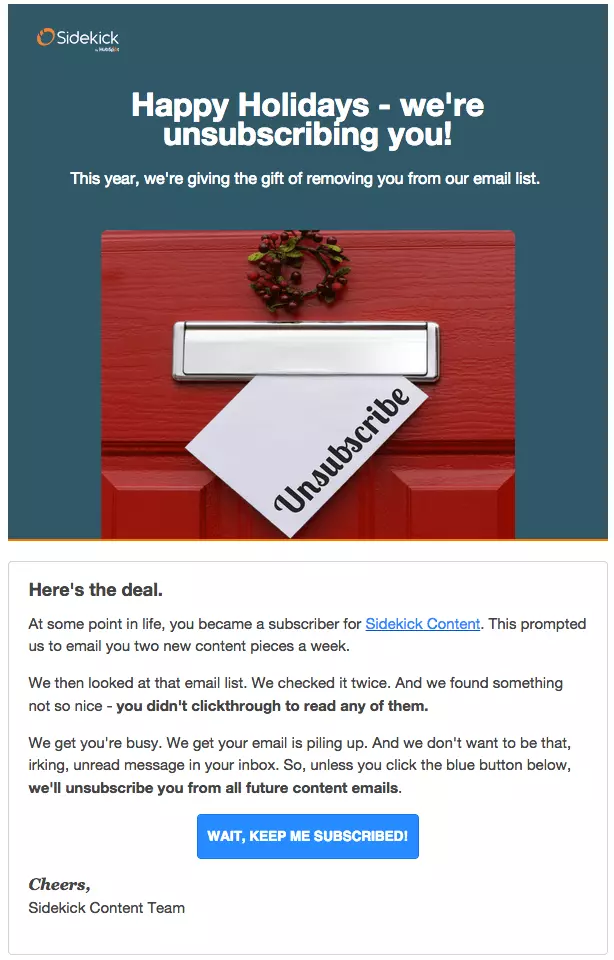
51.9% of marketers reported removing inactive subscribers from their lists, which is great!
Not only does it improve open-rate statistics, but it also improves audience analytics, as you’ll be better able to craft relevant emails with a more focused list.
Accordingly, you should have a plan in place for unsubscription emails. The email above, if a touch snarky, is a great example from Sidekick Content.
Seasonal and event-based campaigns
22. The Holiday Campaign Series: A planned sequence for major shopping periods (Black Friday, end-of-year, Valentine’s Day) with consistent branding, escalating urgency, and clear offers.
What to steal: Plan seasonal campaigns months. The ones that look spontaneous rarely are.
23. The Non-Holiday Seasonal Campaign: Campaigns tied to seasons or milestones your specific audience cares about, such as back-to-school, fiscal year-end, or summer slowdown.
What to steal: The most relevant seasonal emails aren’t always the obvious ones.
24. The Event Invitation Email: Invites subscribers to a webinar, in-person event, or live session. Short on copy, heavy on specifics: what, when, why to attend, and one-click RSVP.
What to steal: Event invitations perform better when the CTA is low-friction, a single click to register, not a form with five fields.
25. The Post-Event Follow-Up: Sent to attendees after a webinar or event with a recording link, a summary, and a relevant next step.
What to steal: The follow-up is often more valuable than the event invite, so don’t skip it.
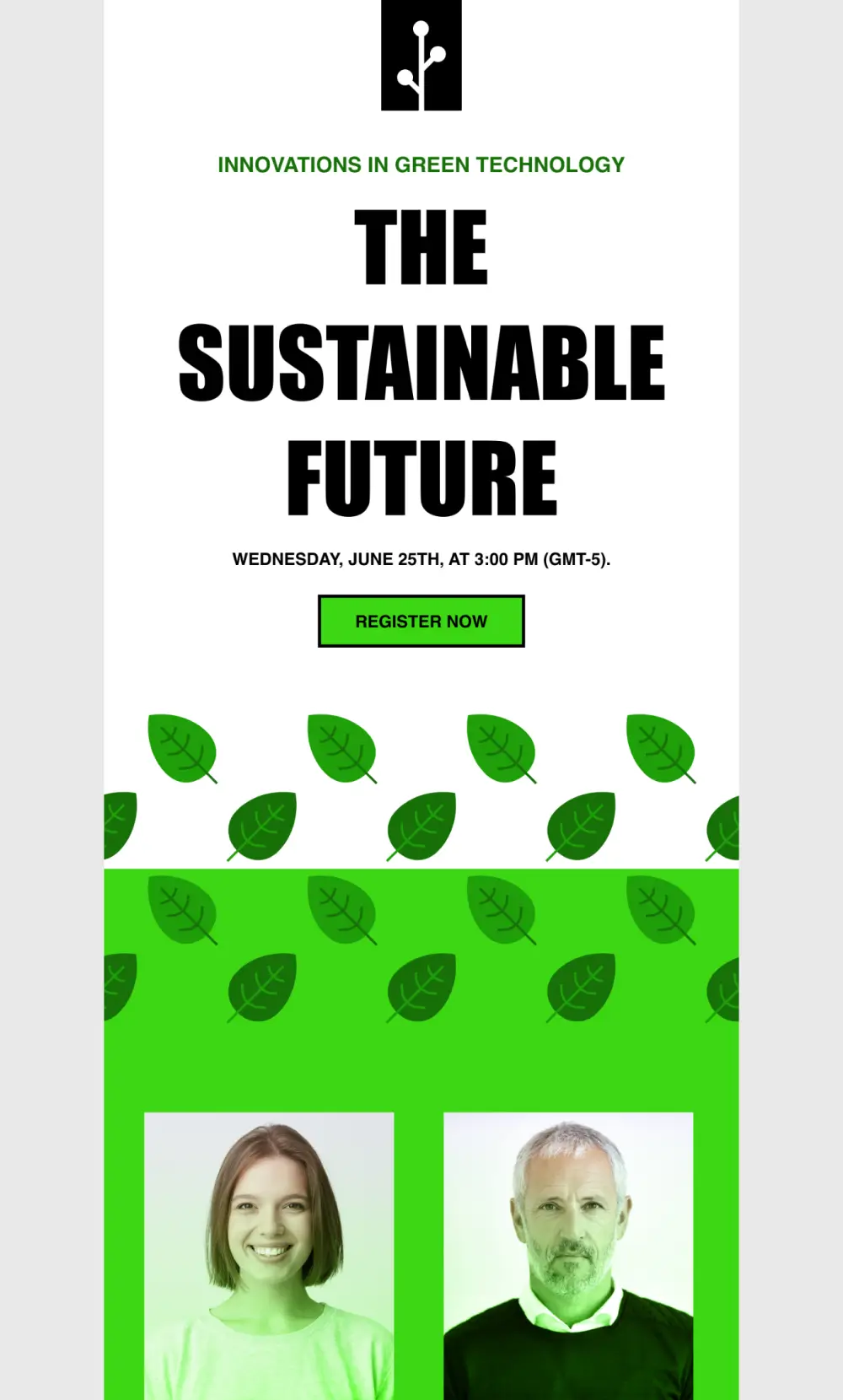
Here’s one of our webinar promotion templates. This is completely customizable; however, we always recommend having the registration button front and center.
Informational and content-driven campaigns
26. The Newsletter with a Point of View: Not a roundup of links, but an editorial: one clear take on something relevant to your audience, with a conclusion and a question.
What to steal: Newsletters with a distinct perspective build stronger audiences than those that just curate.
27. The “Behind the Scenes” Email: A look at something happening inside the business, such as a product being made, a decision being made, a mistake, and what you learned.
What to steal: Transparency builds trust faster than almost anything else in email.
28. The “One Thing” Email: Extremely short. One idea, one resource, one question. Reads in under a minute.
What to steal: Length doesn’t equal value. Some of the highest-click emails are the shortest.
29. The Customer Story Email: Features a real customer, their challenge, and how they solved it with your product or service. Mostly their words, not yours.
What to steal: Social proof in an email context performs better when it’s specific and story-driven, not quote-and-star-rating.
30. The AI-Personalized Digest: An email whose content is dynamically assembled based on each subscriber’s behavior, like articles they haven’t read, products similar to ones they’ve viewed, or topics they’ve engaged with most.
What to steal: In 2026, AI-powered, content-level personalization is increasingly accessible. Even basic behavioral personalization significantly lifts engagement.
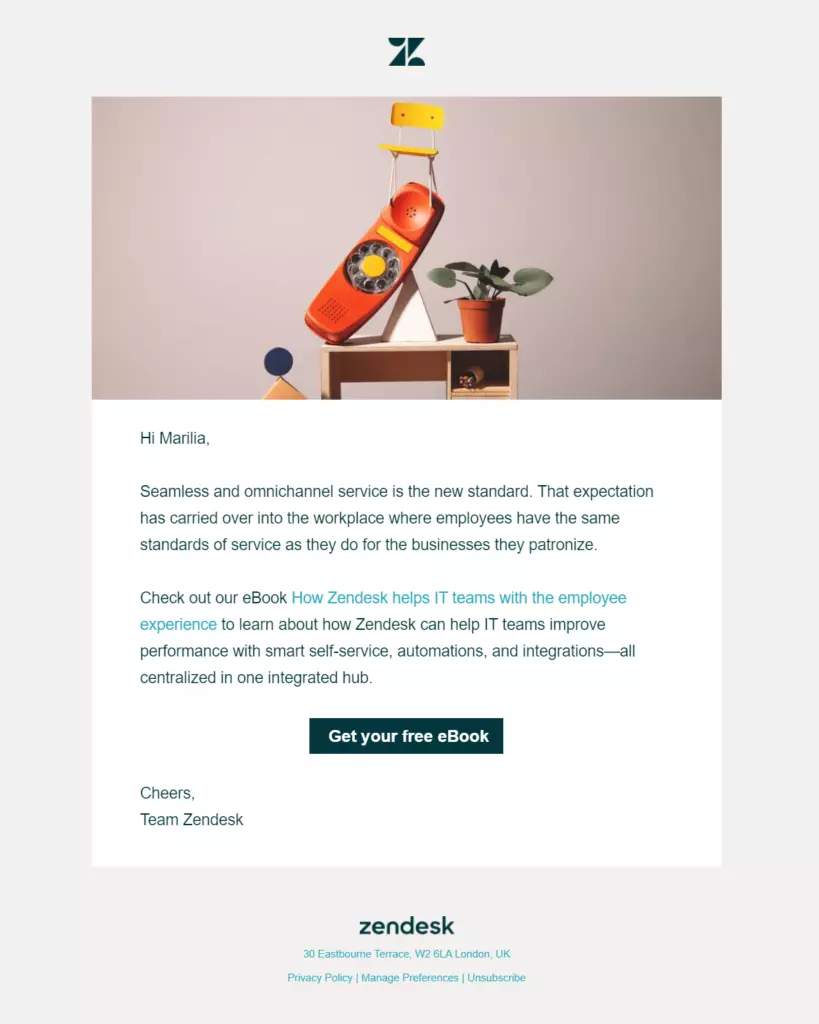
If there’s such a thing as humility in email marketing, Zendesk has nailed it.
This email is not cloying. It doesn’t beg you to take advantage of an offer or click through to some sales funnel. It simply offers some valuable content (in this case, an eBook) with a short summary, giving a glimpse of the content and offering the chance to learn more.
Devilishly simple and dangerously effective.
Frequently Asked Questions
What makes an email marketing campaign successful?
The fundamentals: a clear goal, a relevant audience, a compelling subject line, a single CTA, and a message that delivers value relative to what the subscriber expected when they opted in. Great campaigns nail all five; most struggling campaigns miss at least one.
How many emails should be in a campaign sequence?
It depends on the goal. Welcome sequences typically run three to five emails. Product launch sequences run four to six. Re-engagement sequences run two to four before a sunset email. For any sequence, stop when you’ve delivered the value. Don’t add emails to hit a number.
What’s the best type of email campaign for driving conversions?
Behavior-triggered campaigns, especially cart abandonment, browse abandonment, and post-purchase, consistently produce the highest conversion rates because they’re sent in direct response to something the subscriber just did. Among non-triggered campaigns, time-limited promotional emails with a single, clear offer perform well.
Should every email campaign include a promotional offer?
No. Campaigns that only ever ask for a purchase train subscribers to tune out everything that looks promotional. Mixing in informational, community-building, and story-driven emails builds the trust that makes promotional sends more effective when they do go out.
How do I know if my email campaign is performing well?
Benchmark against your own historical data first. Industry benchmarks vary widely by sector and audience. Consistently improving open rate, click-through rate, and conversion rate over time matters more than hitting someone else’s number.
About the Author:

Content Marketing Manager | Content marketing, inbound funnel, social media, email nurture | Natalie Slyman is an experienced Content Marketing Manager at Benchmark Email with a strong B2B background and a knack for crafting pillar content that boosts SEO and brand authority. She regularly shares actionable insights—from remote-work strategies to AI-powered content workflows—via blog posts and webinars tailored for busy marketers.