



Key Takeaways
- Instagram has over 2 billion active users, with 87% having purchased a product after seeing it on the platform, making it uniquely powerful for eCommerce.
- Video consistently outperforms static content on Instagram, driving higher engagement, better recall, and more purchase intent.
- Reels are currently prioritized by Instagram’s algorithm, giving brands free reach when they post consistently in the format.
- User-generated content (UGC) videos are among the most trusted and effective content types for eCommerce, and they’re free.
- Video ads, especially Reels-based ads, allow brands to precisely target new audiences beyond their existing followers, with measurable results.
- Connecting Instagram video strategy to email marketing amplifies results: use Instagram to grow your list, and email to convert and retain.
Over the years, eCommerce has evolved from an alternative shopping channel to a core part of daily commerce. Global retail eCommerce sales have surpassed $6 trillion, and the competition for consumer attention has intensified accordingly.
Standing out in this environment requires more than good products and a clean website. It requires meeting customers where they spend their time, and increasingly, that means Instagram video.
With two billion active users and an algorithm that actively rewards video content, Instagram has become one of the highest-ROI channels available to eCommerce brands. Here’s how to use it.
Why Instagram video marketing works for eCommerce
Your audience scrolls through hundreds of pieces of content every day. Static images and plain text have a harder time stopping that scroll. Video has a structural advantage: movement, sound, and story all activate attention in ways photos simply can’t.
The data backs this up: according to a report, 86% of people expect brands to produce more video content. And on Instagram specifically, 50% of users have visited a website to purchase a product or service after watching a video on Instagram Stories.
Instagram’s current ecosystem gives eCommerce brands five primary video formats to work with:
- Reels: Short-form, vertical video (up to 90 seconds) that receives algorithmic prioritization and can reach users beyond your existing followers.
- Instagram Stories: Ephemeral 24-hour content with interactive features like polls, countdowns, and product links.
- Instagram Live: Real-time video for product launches, Q&As, and behind-the-scenes content.
- In-Feed Video: Standard video posts that appear in the main feed and on your profile grid.
- Video Ads: Paid placements across Reels, Stories, and the main feed with detailed audience targeting.
Over ten years have passed since Instagram introduced videos in response to the then-popular Vine, and video has become the most effective content format on the platform. This is despite Instagram Stories being an answer to Snapchat and Reels being dubbed a TikTok copycat.
The Meta-owned platform can clearly get away with taking what’s popular and repacking it as its own because Reels has quickly become a favorite format, while Instagram Stories is a classic that hasn’t gone out of style.

Brands that have experimented with Reels have experienced a significant lift in ad recall after adding Reels to their usual placements. A metal poster company called Displate increased its sales by 67% after running Reels ads.
Just like non-video Instagram ads, video content can help you boost brand awareness, engagement, and conversions, except with better results.
5 Ways to use Instagram video marketing to drive eCommerce results
1. Showcase your products through a demonstration video
The fundamental limitation of eCommerce is that customers can’t touch, try on, or experience your product before buying. Video bridges that gap.
Demonstration videos like how-tos, “day in the life” content, unboxing videos, and styling videos help customers visualize what it’s like to actually own and use your product. This visualization is often the deciding factor between adding to the cart and moving on.
Take the approach of athleisure brand Recess: their Instagram videos show real people using products in natural, organic settings, not posed product shots. The content feels authentic because it shows the product working in real life, not just looking good in a photo.
Practical tip: keep product demos under 30 seconds for Reels. Lead with the transformation or result, then explain how you get there.
Check out how athleisure and lifestyle brand Recess uses video marketing to showcase its products on Instagram:

Recess posts “day in the life” videos of people using its different products. This way, customers can easily imagine how the products can work for them in their own lives. What makes the Recess videos so appealing is their organic feel; the brand features its product naturally, without overtly selling.
If you want to bring your business to the next level and create engaging videos for your feed, use video editing apps like Videoleap by Lighricks to help you create out-of-the-box content that will surely capture your audience’s attention. The best part? The app is beginner-friendly and comes with ready-to-use templates from different creators, so you can make and publish IG-worthy video content in just minutes.
Here’s an example of an outfit change transition video created with Videoleap:

2. Maximize reach with consistent reels posting
Instagram’s algorithm currently gives preferential distribution to creators and brands that post Reels consistently. This means your content can reach users who don’t yet follow you for free.
Beyond the algorithmic boost, Reels can appear in the dedicated Reels feed, the Explore page, and as suggested content in the main feed. A single well-performing Reel can generate thousands of impressions that wouldn’t be possible with a static post.
To maximize Reels performance, focus on native creation (shot vertically on a phone rather than adapted from horizontal footage), trending audio when relevant, and hooks in the first two seconds that give a viewer a reason to keep watching.
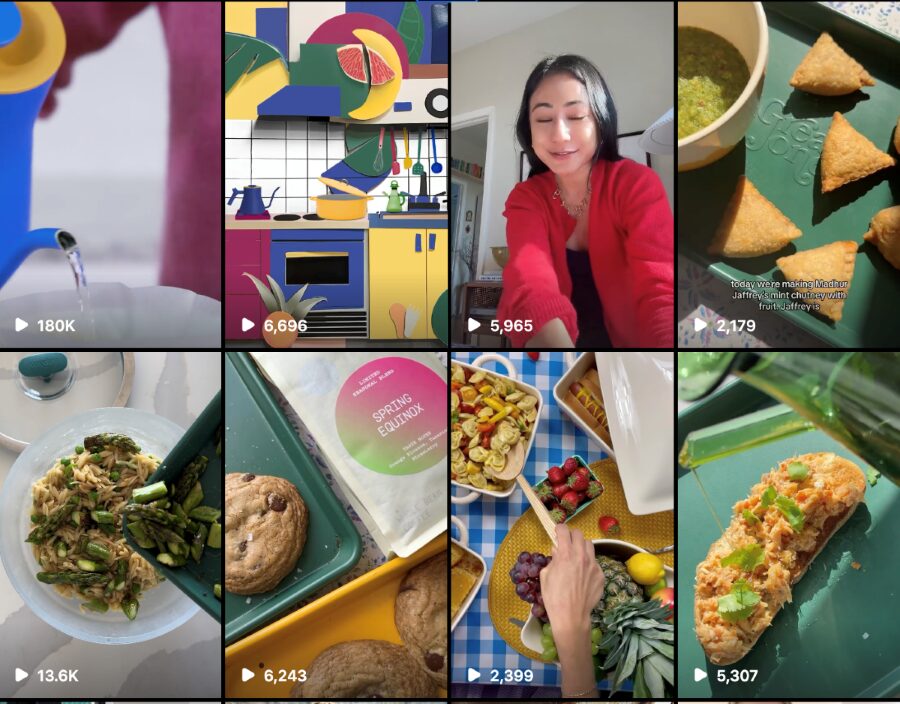
Cookware brand Great Jones regularly posts Reels, ensuring it stays on top of its followers’ feeds, boosted or not. As a result, it leads to more IG reels views and, therefore, a wider audience of potential customers may discover their products.
3. Leverage user-generated content
User-generated content (UGC) is the most trusted content form available to eCommerce brands; more persuasive than any ad your creative team could produce. When customers and creators share their genuine experience with your product on video, it functions as peer-to-peer social proof.
About 77% of users say they would create content for a brand if rewarded. Incentivize UGC through discounts, free products, affiliate commissions, or simply the promise of being featured on your brand’s page. Then repost and amplify, with permission, across your own channels.

Sauce brand Fly By Jing has built a substantial portion of its Instagram presence on creator and customer video content, and the authenticity of that approach consistently outperforms polished brand-produced content in engagement metrics.
To help you engage with your audience, collect UGC, and publish content without breaking a sweat, you can use Buffer. The platform offers scheduling and engagement tools to help you manage your Instagram account from a single, easy-to-use dashboard.

4. Build anticipation with teaser campaigns on stories
Instagram Stories’ ephemeral format, which causes content to disappear after 24 hours, creates natural urgency for selling products. Combine that with Instagram’s countdown sticker, and you have a built-in anticipation engine for product launches, sales, and announcements.
Tease your product before the reveal. Show it from different angles without full disclosure. Use music to build energy. When the countdown ends, notifications go out to everyone who opted in, driving a concentrated burst of traffic at launch.
You can use the storytelling nature of Instagram Stories to build up your product before the full reveal. Take a look at how the makeup and skincare brand Sunnies Face does it:

Sunnies Face used this approach to tease their Fluffbalm lip product: a multi-day Stories sequence that showed the product without revealing enough to satisfy curiosity, building anticipation before the full launch.
5. Invest in video ads to reach new buyers
Organic video will get you a long way on Instagram, but paid video ads are how you systematically scale reach to audiences beyond your existing followers.
Instagram video ads, particularly Reels-format ads, allow you to define your audience precisely: demographics, interests, behaviors, and lookalike audiences based on your existing customers. This targeting means your ad spend reaches people who are genuinely likely to be interested in your product.
The most effective eCommerce video ads don’t look like ads. They use the same authentic, native aesthetic as organic content, often starring real customers or creators rather than polished spokesmodels.
If you want to create authentic video ad campaigns for your company, find brand ambassadors and ask them for video endorsements, which you can later boost with branded content ads.
UK footwear brand Deichmann tested Reels-based video ads during the back-to-school season, adapting TV campaign content into native-format Reels with multiple CTAs. The campaign achieved a 2.9-point lift in purchase intent and an 8-point improvement in ad recall.

Connecting Instagram video to your email strategy
Instagram builds awareness and drives discovery. Email converts and retains. The two work best together.
Use Instagram video to drive subscribers to your email list. Include a swipe-up link on Stories that leads to a signup landing page, or direct Reels viewers to a link-in-bio opt-in with an exclusive offer. Once they’re on your list, your email campaigns can nurture the relationship, recover abandoned carts, and drive repeat purchases.
Platforms like Benchmark Email make it easy to follow up on Instagram-driven traffic with welcome emails, product-recommendation emails, and post-purchase campaigns that turn one-time buyers into loyal customers.
Frequently Asked Questions
What type of Instagram video performs best for eCommerce?
Reels currently drive the most organic reach on Instagram due to algorithmic prioritization. Specifically for eCommerce, product demonstration Reels and UGC reposts tend to generate the highest engagement and purchase intent. Stories work well for time-sensitive offers and launch campaigns.
How often should an eCommerce brand post Instagram Reels?
Most Instagram marketing experts recommend 3–5 Reels per week for brands actively building organic reach. Consistency matters more than volume. It’s better to post 3 high-quality Reels reliably each week than 7 inconsistent ones.
Do I need professional video equipment for Instagram video marketing?
No. Native, smartphone-shot video often outperforms studio-produced content on Instagram, particularly in Reels and Stories formats. Audiences respond to authenticity. A modern smartphone, decent lighting (natural light works well), and good audio quality are all you need to start.
How do Instagram video ads compare to static ad formats?
Video ads consistently outperform static image ads on Instagram for recall and purchase intent metrics. Reels-format video ads, in particular, see higher engagement rates than other formats. The investment in video production typically pays off with lower cost per click and higher conversion rates.
How can I track whether an Instagram video is actually driving eCommerce sales?
Use UTM parameters on any links you include (swipe-up links, link in bio, Stories links) to track Instagram-sourced traffic in Google Analytics. For Instagram Shop, native analytics provide conversion data. Combine this with email attribution from your marketing platform to understand the full customer journey from Instagram discovery to purchase.
